 FaithSow
Helping without taking over: how to practise asking first with your child
Your child sees another child struggling with a task and reaches over to finish it. “I was only helping,” they say. You want to keep that willingness to care, while making room for the other child to decide whether help is wanted.
For this everyday situation, try separating the offer from the action. Your child can ask a short question, wait for the answer, and leave the task with its owner if they want to keep trying. FaithSow's public situation page gives you a question and a parent note to start that conversation together.
Start with “What could you ask them first?”, then expand For parents. You can use this question and parent note without opening a full story.
Recognize the helpful intention and pause the takeover
The FaithSow situation describes a child seeing a peer work slowly, taking the object from their hands and trying to finish for them. Its parent note encourages recognizing the good intention while reminding the child to ask and respecting the peer's wish to try independently.
You might say: “You wanted to help. Let's ask whether they want help before we take over.” Keep the focus on the next action rather than labelling the child as bossy or unkind.
If the object has already been taken, an ordinary next step could be to give it back and make an offer instead. The point is to return the choice to the person doing the task. In a dangerous situation, an adult may need to act immediately to protect someone.
Practise a question that leaves room for an answer
The public page asks, “What could you ask them first?” It also invites children to respond by speaking, pointing or acting something out. You can listen to your child's wording before offering your own.
For example, a child might ask: “Would you like help, or would you like to try yourself?” If help is welcome, they can follow with, “Which part would you like help with?” Let your child use words that feel natural to them.
Give the other person time to answer. Asking and immediately grabbing the object still leaves little choice. If the answer is no, practise a simple response such as “Okay, you can keep trying.” There is no need to ask repeatedly until the answer changes.
Make the practice about both children
At home, you can briefly act out the two roles. One person is working on a familiar task; the other offers help without touching it. Let the person doing the task choose yes or no, then swap roles if your child wants to.
Keep this offline practice brief and relaxed. Notice both the offer and the answer, without turning it into a test or expecting the next real interaction to go perfectly.
If your child is disappointed when help is declined, you can acknowledge that feeling while keeping the other person's choice. Wanting to be useful does not require someone else to hand over their work. Your child can offer again on another occasion without treating today's answer as a judgement of their worth.
Use FaithSow for the conversation before choosing a story
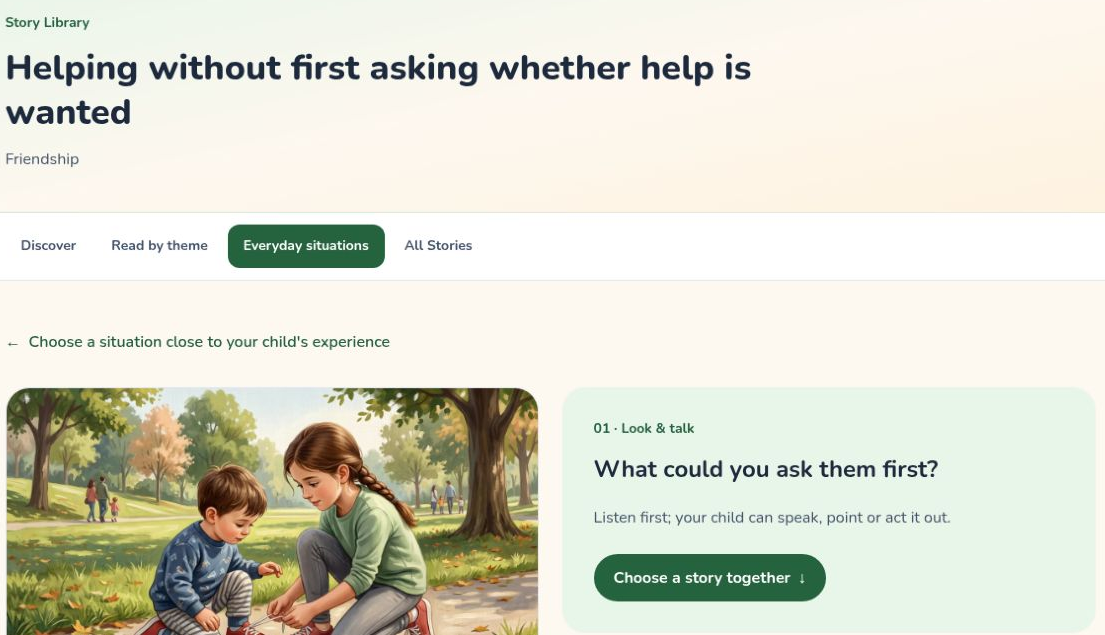
Open the same-language situation page and read the short description together. Use its opening question, then expand For parents. The supporting illustration shows an older girl tying a younger boy's shoe. Read it alongside the situation text and talk about what the child could ask before helping.

The page recommends Paul Preaches in Rome, The Birth of Jesus in a Manger, and War with the Amalekites. Read the public card descriptions for their connections with care, asking about needs and respecting an answer.

All three recommended cards currently state that sign-in or access to the story is required. A recommendation is not a promise of free access. You can use the public question and parent note without opening a full story. If you decide to read one, check your access and your child's interest first.
One small step for today
Choose an ordinary moment when no one is rushed or in danger. Ask your child how they could offer help, and practise allowing either answer. Keep the invitation short enough to use naturally.
Return to the public FaithSow question for a short conversation. Listen to your child's idea, then practise asking and waiting for the other person's answer.